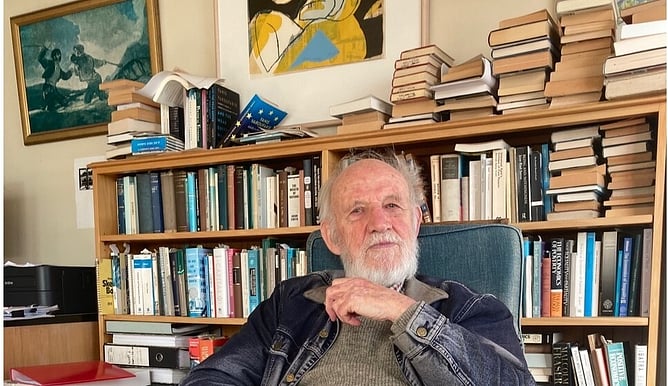
Dennis Rose: An Obituary
Long-time Paekākāriki resident Dennis Rose passed away on February 6, 2026, aged 92. While Paekākāriki locals might best remember Dennis for his ever-decreasing walking circuits of the village, Dennis leaves behind a legacy of research. This includes his efforts to find Pouawha.
Long-time Paekākāriki resident Dennis Rose passed away on February 6, aged 92. He had just moved into Coastal Villas, after 40 years living on the beachfront in Ames Street.
Paekākāriki locals might best remember Dennis for his ever-decreasing walking circuits of the village. Dressed in sensible leather shoes, shorts, even on the coldest days of winter, and a smart tweed jacket; in later years, using two sticks to help his balance.
My first walks with him, decades ago, were circuits that included tracks in Queen Elizabeth Park. These began shortly after he hired me as a research economist at the New Zealand Planning Council. It was the late 1980s, around the time he moved to Paekākāriki where I was already living. We quickly moved from colleagues to friends. On these walks we often discussed projects that we were jointly working on.
The 1980s and early 1990s, before the Planning Council was shut down by the National government, was a time of significant economic and social upheaval. Like now, there were periods of high unemployment.
One small, but notable, publication that came out of that time was ‘The fully employed, high income society.’ It did not have a fancy cover. But it was full of detailed analysis.
This publication embodied Dennis’s approach to economics. Perhaps reflecting his original intention to train in theology, his one-time membership of Socialist Forum, and his father having once stood for Labour, Dennis was always interested in the wellbeing of people. The economy was there to serve people, not the other way around.
Dennis was widely read in economics and an extensive range of other topics; a competent statistician who knew how to use economic models. But like certain well-known economists of his era, he was a ‘political economist.’ Evidence was always his starting point. This was often based on existing data collections, such as those produced by Statistics NZ, an organisation he once worked for. But, often, he drew on his own deep investigations into sectors of the economy, including the car industry, cement, forestry, railways, and road freight. He would frequently leave the office to talk to people and visit factories.
But Dennis was also pragmatic. Through his work in the public sector, he realised politics would ultimately determine which policies would be feasible. Yet he was not scared to challenge authorities, as shown by his chairing of the New Zealand Council for Civil Liberties. He was also active in opposing the Vietnam war.
In a time of increasing specialisation, Dennis was a polymath. He worked on trade issues, was an early explorer of the Māori economy, delved into interest rates, wrote a research paper exploring major issues likely to arise in designing a republican constitution, particularly those relating to the role and powers of the head of state. And in his last weeks of life, Dennis was finalising a paper on monetary policy.
But it is Dennis’ study on the location of Pouawha that will be his lasting legacy in Paekākāriki. He started from an observation that puzzled him: Rachel Benefield’s mural (at the Paekākāriki railway station carpark) of the mountain Pouawha behind Paekākāriki.
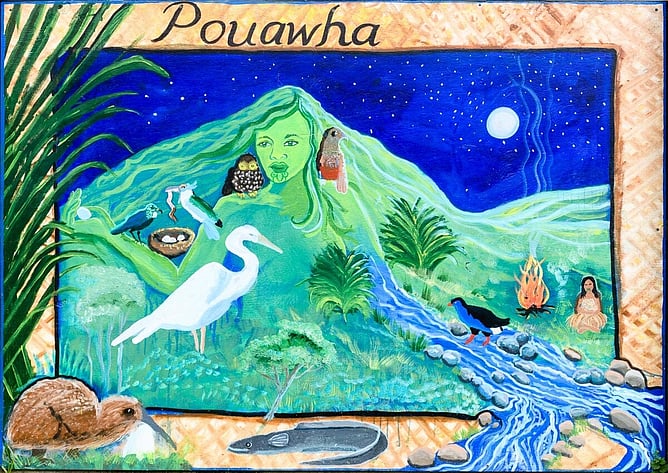
But where was this mountain? This question led to a journey of research and discovery. He pored over maps, read historic journal accounts, talked to knowledgeable people, and stood in various places around the village trying to figure out Pouawha’s location. He even asked me to climb Mt. Wainui to help in the investigation, which I did, and to take photos from out at sea to determine whether they matched up with historic paintings.
At the same time, he became fascinated with the Boulcott Farm conflict that culminated in the fight at Battle Hill, and led to the strategic, but gruelling, retreat of Te Rangihaeata and his followers in the depths of winter across Mt Wainui and the mysterious Pouawha. He wrote this up and, helped by Dave Johnson of the Paekākāriki Station Museum, held a display at the Paraparaumu library. This display is now permanently located in the Paekākāriki Station Museum. In the end, Dennis decided that Wainui and Pouawha were likely the same mountain.
Many of us will miss the inspirational, daily walks by Dennis in his 90s. Cheering him on, hoping he would make it back to his house on Ames Street, but also knowing that if he ran out of steam someone would pick him up and take him home. He often ventured as far as the steep slopes of Campbell Park. Here, on the seat near Memorial Hall, he met Jeanne Olds – his long-time companion following the death of his wife, Lisa. Sadly, we no longer need to worry about that great man making it home again.