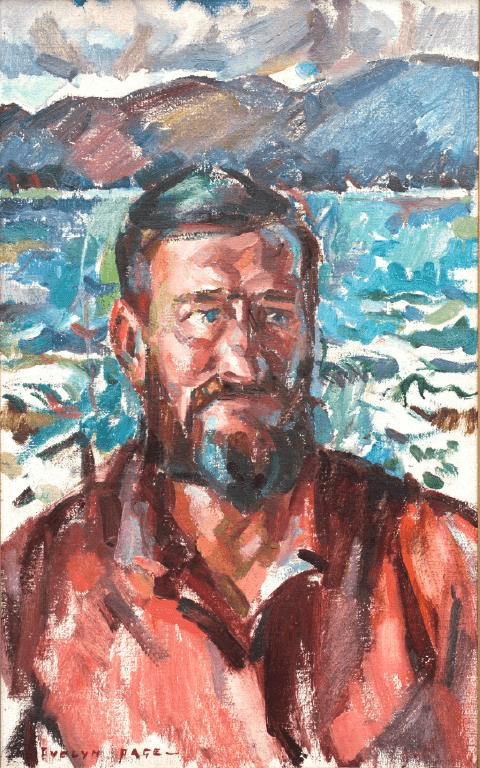
Poet Denis Glover
Denis Glover : The Poet's Years in Paekākāriki
By Judith Galtry
Denis James Matthews Glover DSC (9 December 1912–9 August 1980) was one of New Zealand’s best known and most prolific poets, satirists, and publishers. Between 1959 and 1970, he lived in Paekākāriki where his Ames Street cottage offered spectacular views of the sea and Kāpiti Island. But, most importantly, it was only a short walk from the railway station and his beloved Paekākāriki Hotel.
The multi-talented Glover is described as one of ‘New Zealand's most quotable poets.’
‘His best verse, evincing a timeless simplicity and directness, is built to last – even when Glover declares the opposite: “Verses, verses, what are they? / The wind will blow them all away.” … [H]e is New Zealand's best poet of the mountains and the sea, the author of some strikingly original love poems, a superb lyricist and satirist. His style is completely individual: idiomatic, tough, sardonic, flexible, and spare, marked by glittering imagery and a deft use of assonance and rhyme.’[1]
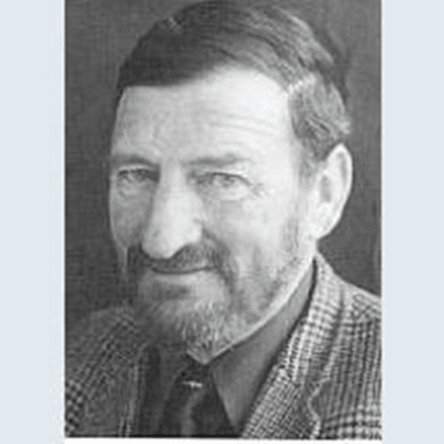
Denis Glover, 1973
(Photographer unknown).
Glover was born in Dunedin in 1912, the third of four children of Irish-born dentist, Henry Lawrence Glover, and his wife, Lyla Jean Matthews. His biographer, Gordon Ogilvie, writes:
‘From his Irish ancestors Denis Glover evidently derived his wit, devilry and frequent bloody-mindedness; while from Lyla's wide reading and ambitions to be a writer he acquired his literary instincts.’[2]
Following his parents’ separation, he lived with his mother and siblings in many parts of New Zealand. His schooling included Dunedin's Arthur Street School; New Plymouth’s Central School (where he was Dux); New Plymouth Boys' High School; Auckland Grammar School (where he excelled in English); and Christ's College. In 1931, he enrolled at Canterbury College, where he took Greek, Latin, Philosophy, and English for his B.A., and was an active sportsman playing rugby, boxing, and sailing. He also joined the Canterbury Mountaineering Club and Christchurch Classical Association.
In 1936, Glover married Mary Granville and their only child, Rupert, was born in July 1945.
One of Glover’s most significant achievements was his founding, with John Drew, of the Caxton Press in Christchurch in 1935. Under Glover’s guidance, Caxton ‘did more than any other to help good writing in New Zealand and to raise publishing and book production standards.’[3] It published the early works of many well-known New Zealand writers, including several of Glover's own poems.
Glover was also a war hero. During World War Two he served with the Royal Navy and landed an infantry craft at Normandy on D-Day, earning him the Distinguished Service Cross. He also made four 'suicide' voyages to Murmansk with the Russian convoys delivering essential supplies to Russia, a Western ally against Nazi Germany. His wartime service earned him a Soviet War Veteran’s Medal in 1975 at the height of the Cold War, as well as ongoing surveillance by New Zealand’s Security Intelligence Service.[4]
In 1944, Glover returned to New Zealand, married life, and his work at Caxton. Friends recall that around this time his drinking got heavier. He nevertheless continued to publish significant new work by emerging and established authors, as well as two new collections of his own new poetry; among them, the legendary verses Sings Harry (1951) and Arawata Bill (1953).
Glover’s marriage ended in 1950, after he got together with Khura Skelton. Although they never married – an ongoing source of bitterness for Khura - they stayed together until her death in Paekākāriki in 1969. By 1954, with his career in Christchurch on the rocks and the demise of Caxton Press, Denis and Khura moved to Wellington, soon followed by a shift to Raumati South to a cottage (The Ranch) on a steep hillside. From here they both commuted to work in Wellington. After a dispute with their Raumati landlord which ended up in court, they moved to Paekākāriki in April 1959. A chance conversation at the Paekākāriki Hotel led them to the small stucco cottage at 66 Ames Street, which Denis finally bought in 1964, with financial help from Khura’s aunt, Ida Stuart. In a letter to a friend, Glover describes the view from his cottage:
‘…there’s a wonderful seascape, with the South Island in glorious view under the westering sun, and an offshore bird sanctuary (Kāpiti) five miles out the window. A boat would present a puzzle as the beach is open and apt to be treacherous and boisterous. Sailing dinghy, all right, by dragging it through beaching stations, but I want something bigger. We’ll see.’[5]
The Paekākāriki seascape was to influence his poetry over the next decade.
Most mornings, Glover walked his ‘affectionate spaniel pup,’ Algernon (given to him by poet Alistair Campbell at Pukerua Bay), along the south end of the beach and through the village to the pub.
‘Often after my early morning walk on the beach with my dog…I called in at the pub about seven in the morning, knowing my devious way in, ‘twixt-hours drinking being an old hobby. There [Denis Aspell (Dinny), the publican] would be, poring over figures in his little office under the stairs. “Can I get a drink thirsty after a long walk on the beach?” He would go out and bring back a couple of bottles of beer and was affronted when I fished out money. “Denis Glover, I know to a sixpence what you and Khura spend in the bar, but in here you are my guest, and a welcome one at that.”’[6]
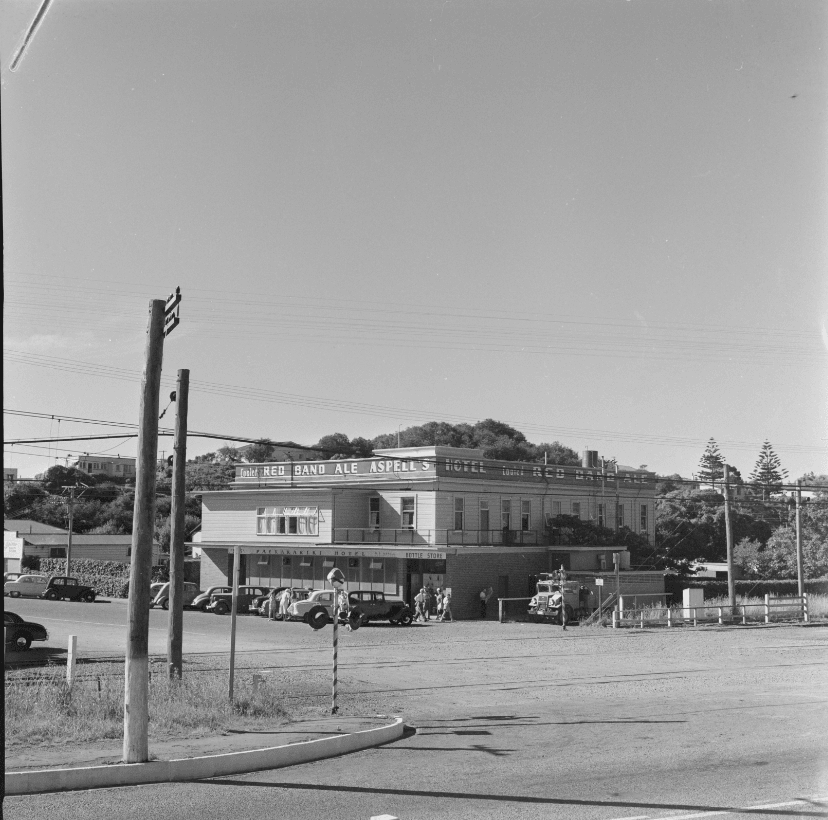
The Paekakariki Hotel – 1957
(Evening Post collection, unknown photographer).
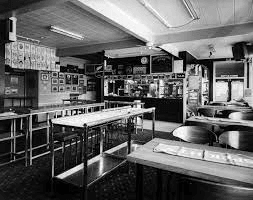
Interior, Paekakariki Hotel, 2004
(Photograph by Andrew Ross).
The Paekākāriki Hotel also served as poste restante for parcels that Denis wanted to hide from Khura. Writing to an ex-Royal Navy comrade, Glover instructed: ‘Snuff… As Khura goes mad when I take a pinch (on the grounds that it leads to brain damage, ha!) you might address it me c/o D.B. Aspell, Hotel Paekākāriki, and then I can snuff up overlooking our loved and feared rolling ocean, named for Tasman that redoubtable seaman and drunkard.’[7]
In his biography, Gordon Ogilvie notes: ‘The Glovers enjoyed the carefree village atmosphere at Paekākāriki and soon became well known in the district for their drinking, histrionics, colourful altercations and generally Bohemian behaviours.’[8] Several literary friends lived nearby, including Monte Holcroft, then editor of the Listener, and the Glovers attracted people to the Paekākāriki Hotel at weekends where their ‘hospitality, drinking bouts and high-decibel ructions became legendary.’[9] Dunedin poet, Brian Turner, recalled a night at the hotel, with Denis ‘stumbling and falling’ about the dance floor. And poet and writer, Vincent O’Sullivan, recounted the story of visiting Glover at home in Paekākāriki where the ever-hospitable Denis sought out refreshments by feeling around in the sand with a stick. On hearing a clunk, he fished out a bottle of gin and carried it to the kennel, ‘” On the flight deck, Admiral!” commanded Glover. Algernon climbed obediently onto the roof of his kennel and raised a paw in salute.’[10]
But most of all, people remembered Glover’s ‘rich, posh voice’ and his memory for reciting poetry. [11] Author, James McNeish, spent a weekend at Paekākāriki in 1964 so that he could record Glover reciting his poems. To McNeish’s great disappointment, Glover was unable to recite The Magpies, perhaps his best-known poem.
But there was a dark side to the often fiery and argumentative Glover, which manifested itself in heavy drinking and self-destructive behaviour. Ogilvie describes him as ‘someone who relished life but wrote much of death and knowingly destroyed himself with drink.’[12]
‘Glover had an Elizabethan breadth of talent and fullness of character. He was, among other things, scholar, adventurer, typographer, publisher, poet, author, critic, raconteur, performer, drunkard and lusty lover. A man of sometimes anarchic temperament but warm humanity, Glover was impatient with prudery, shoddiness, pretence, political chicanery, officialdom or anything mean-minded. Faults he admitted to include an unrepentantly monocultural and masculine view of society and of literature, an 'immodest enthusiasm for draught beer' and a tendency to shed 'printing presses, wives and books' as he went.’[13]
During those spells when he was out of work, Glover used to stroll down to the Paekākāriki Hotel around 5 o’ clock each afternoon to await Khura’s arrival on the unit from Wellington. Paekākāriki was then the end of the electrified rail section from the capital. These were the days of 6 o’ clock closing; but Dinny, the publican, would often invite the Glovers into the lounge bar after closing time. Sometimes the local policeman, Constable Valentine (Val), would join them. These late night drinking sessions aside, the poet and the policeman had an ambivalent relationship.
Paekākāriki local, Louisa Warren, recalled watching Denis sitting in the hotel’s Ballerina Bar, reading his galleys with a large tray of drinks beside him. ‘When he was with Khura he’d have three gins in a glass and fill it up with beer so Khura would think he was just having a beer. I don’t know how he survived as long as he did.’ [14]
Denis was clearly unhappy much of the time that he lived in Paekākāriki. In a letter to his close friend, librarian-scholar, Olive Johnson, he wrote:
‘Fact is, I’m not satisfied with my life, nor the daily routine, for so little purpose. So I spend as much time as I can gently washed by waves of booze. Up at 5.30, train at 6.50, awful morning tea at 10.05. A scurried hour 12-1. More dirty tea at 3pm. At 4.20 down biro, & a bloody rush to the station, with no time for more than a couple of doubles. Paekak. Pub at 10 to 6 – same old faces in the same old places, including K, …What am I supposed to do then? Write immortal poesy until 9 o’ clock news? With the (dear old) aged aunt lying patiently for a second cup of tea and a fresh hottie.’[15]
The Glovers were great entertainers. But as time went on their relationship became increasingly volatile. A neighbour later described her time living next door to Denis and Khura:
‘Sometimes I’d hear screaming and I’d look out and see Khura chasing him around the garden with the hose, and he’d have no clothes on. It was really bedlam living next to them...Many a time I’ve seen him lying in the gutter in Ames Street, absolutely unconscious, and I didn’t dare touch him…..’ [16]
Yet many locals were also witness to Denis’s better nature. Playcentre supervisor, Sondra Fry, recalled how he would help those mothers struggling to lift the heavy sandpit covers. ‘He’d come in, lift off the covers, not say a word, and walk out again.’[17] And Enid Milne, a beachfront gardener, received advice on how to grow vegetables in sandy soil, i.e., to lay beds out ‘like a cemetery,’ ‘about 6 x 2 with enough space to walk between them’.[18] Denis himself was an expert gardener, planting his carrots in the shape of a ship’s compass.
When approached to write a song to commemorate the Paekākāriki Old Folks Association, Denis initially agreed. But when the group’s secretary saw him a few weeks later, he said he couldn’t do it: ‘Every time I sit down to think about writing it, all I think is, oh dear what can the matter be? Three old ladies locked in the lavatory.’[19]
Others described Glover dressed up in full naval regalia for the Paekākāriki Anzac Parades or when there were visits by American servicemen who had spent time at Mackays Crossing Marines’ training camp during World War Two. In this attire, according to John Lehmann, editor of London’s Hogarth Press, Glover looked ‘rather like Mr Punch in naval uniform, sturdy, stocky, sanguine of complexion and temperament, a man in a million, imperturbable and with a great sense of humour.'[20] And Ken Buck, an ex-naval man who had been at Guadalcanal during World War Two and was then living in Paraparaumu, told of going to the Paekākāriki hotel to meet the first batch of American marines arriving to celebrate their time in the village. When he got there, ‘there was a chap on top of the bar in naval uniform, giving a welcome address. And [I] said to someone, ‘Who’s that bloke up on the bar?’ [I] was told it was Denis Glover.’[21]
Yet, says Ogilvie, ‘[w]hile boozing, arguing and scrapping were what typified the Glovers in the eyes of most of the Paekākāriki locals, there was a kinder, and more considerate side to be seen as well. Khura and Denis were hospitable to a fault, especially if you drank.’[22]
One recipient of the Glovers’ largesse was William Broughton who was writing a PhD on poets D'Arcy Cresswell, A. R. D. Fairburn, and R. A. K. Mason. Denis invited him to write at Paekākāriki while he and Khura were working in Wellington. Of his time in Paekākāriki, Broughton recorded:
‘Denis [and Khura] were warmly hospitable to a fault. I would come out by train in the morning, arriving about nine o’ clock, when both had gone into Wellington to their work... Denis gave me his work desk in the front sun porch looking directly out over the sand dunes to the surf line about 30 metres away. It was a hypnotic view of ‘Tasman’s Bay,’ as Denis correctly insisted on calling it. The Fairburn papers and letters were neatly boxed and at my disposal, and the fridge and the larder in the kitchen (‘the Galley’ of course) invariably had a lunch prepared and left for me. Denis would come home at about 4pm and we would repair to Dinny Aspell’s pub for about an hour until I would take the 5 o’ clock train back to the city. Hospitable kindness is what I most remember, and next to that a conversationalist whose knowledge both of contemporary New Zealand writing and also of English literature, especially Elizabethan and seventeenth century, excelled any other of my teachers then, or for that matter since.’[23]
Glover had several works published during his Paekākāriki epoch. These included A Clutch of Authors and a Clot, 1960; Hot Water Sailor, 1962; Denis Glover’s Bedside Book, 1963; Enter Without Knocking: Selected Poems, 1964, and Sharp Edge Up: Verses and Satires, 1968. Some of his work, including The Magpies, was also set to music by part-time Paekākāriki resident, composer Douglas Lilburn.
During his Paekākāriki years Glover kept up a sporadic working life. From 1954 to 1961 he worked for Wingfield Press under Harry H. Tombs. But this led to a split in 1961 when Tombs accused him of stealing printing business for his newly created Mermaid Press. Glover resigned in protest. Reflecting ruefully on this argy bargy with his former patron, he wrote, ‘Lord what fools these mortals be. I do not except myself.’[24] But the period of respite that followed was not entirely unwelcome.
‘I had a good meditative loaf at Paekākāriki, actually enjoying lack of income, somehow never quite destitute. Leisure to talk to people and to gaze on the outrageous, smiling or silly sea was better than balsam for a self-affronting arrogance. For a glorious time I lived the life of a pseudo squire, reading and scribbling in sunshine, assiduously attending a goodly vegetable garden. Then I would stroll on the beach with dog Algernon or call on people I knew. For the first time I had leisure to savour humanity in the round, and found it good in all its fifty-seven varieties.’[25]
Despite glowing references, Glover’s various job applications, including for the position of vocational guidance officer in Lower Hutt (!), were unsuccessful. His work dwindled due to his increasingly heavy drinking. Then, in 1962, he landed a job as printing tutor at the Technical Correspondence School in Wellington. This income helped with rent and housekeeping.
The Glovers, primarily Khura, also cared for aging relatives at 66 Ames Street. When Denis’ mother, Lyla, was dying she was cared for by Khura before being transferred to a nursing home in Paraparaumu. Glover wrote to a friend:
‘When mother was in the Convalescent home at Paraparaumu I simply drove the old Singer off its wheels going to see her…But I found a nice little 1948 Morris 8 in the village (owner must sell – he’s in jail), hit Reeds up for an advance on Hot Water Sailor and am now modestly mobile again.’[26]
Just prior to her death Lyla asked to return to Paekākāriki where she ended her days on 22 September 1962. According to Glover, ‘The old mother died at my place on Saturday night. The last week was not easy, but she made a good end. We buried her on Tuesday from a simple country church in a beautiful country graveyard.’[27]
An argument ensued between Denis and his older brother, Lawrence, then living in England, over the lack of a headstone. Khura’s son later described to Ogilvie an amusing sequence of events:
‘Sometime after the burial, when Paul Skelton (Khura’s son) was visiting the Glovers at Paekākāriki, the decision was made to place a marker on Lyla’s grave. Denis and Khura, ‘both pissed as newts,’ appointed 15 year old Paul to be their unlicensed driver, and a large stone was obtained from a quarry and loaded onto the suitcase rack at the back of the Singer. Paul was too short to get any view of the road ahead except through the spokes of the steering wheel, and when the rock weighed down the back of the car he saw even less. Somehow, he made it to the Paraparaumu cemetery and after driving up and down the rows of graves for a while they found Lyla’s last resting place. The stone was dumped at the head of the grave and Paul took the Glovers home for further refreshments.’[28]
Khura also provided intermittent care for her aunt, Ida Stuart, who helped pay the mortgage for the Ames Street cottage. In a letter to fellow printer and friend Bob Lowry, Denis reported that, ‘Khura has been south to deal with an aged ailing aunt (the one with the chips) and was masterly enough to lead her back into captivity. She’s an old pet, & no trouble. On top of that the owners of abode above [66 Ames Street] have quarrelled & want to sell. It was buy or get out, so I am now scuttling about for £3,800. Curiously, it looks easier than raising a tenner.’[29]
Ida’s presence turned out to be a mixed blessing. Denis wrote to a friend complaining, ‘It is a little tiresome hanging around here with only K’s Aged Aunt for company during the day. I am running out of excuses for ducking down to the village at any time from 9am onward and have to fall back on the washhouse for the odd go at the flagon most of the time.’[30] Ida took Denis’ banter in good stride, although less so, as a teetotaller, his and Khura’s drinking.
Life at 66 Ames Street became increasingly fraught. Sometimes, to avoid going home, Denis would get on the long-distance train in Wellington and ‘forget’ to get off at Paekākāriki, ending up on a friend’s couch in Auckland.
Khura died at home, unexpectedly, at age 57, on 25 July 1969. The details of her death were hotly debated by Paekākāriki residents, but her death certificate cited bronchopneumonia, myocarditis, and cirrhosis of the liver.[31]
After Khura died Glover began drinking even more heavily and was hospitalised with respiratory problems. In a letter written in March 1970 from Ewart Hospital, he reported that some ‘want me to take a flat in Wgton (where there’s not a landlady would put up with me for a week) and keep Paekākāriki as a holiday retreat. But sell that place I won’t.’ [32] In the same letter he also claims that he would never marry again. He ended up doing both.
While Glover was recuperating up north, Algernon was ‘captured’ by the local constable and put down, after allegedly ‘biting and frightening old woman going about their shopping’[33]. Denis, who only learnt of this afterwards, was devastated. Soon after, he took up temporary residence in Wellington; initially with his son, Rupert, in Worser Bay, before setting up on his own in Hataitai. The Paekākāriki house was eventually sold.
In 1971, after various romantic entanglements – his letters show he was courting several women simultaneously - he met Evelyn [Lyn] Cameron at a poetry reading. They married soon after, with Glover’s divorce from Mary granted. Lyn offered him the stability he needed to write and the next few years saw ‘a whole new outpouring of creativity.’[34]
Glover died in Wellington Hospital on 9 August 1980, following a fall a couple of days earlier.
In 1996, sixteen years after his death, the Paekākāriki Community Arts Trust organised an event at the Paekākāriki Hotel to celebrate his life and works. Various poets, writers, musicians, old friends, and neighbours came together to read poems both by and about Glover.
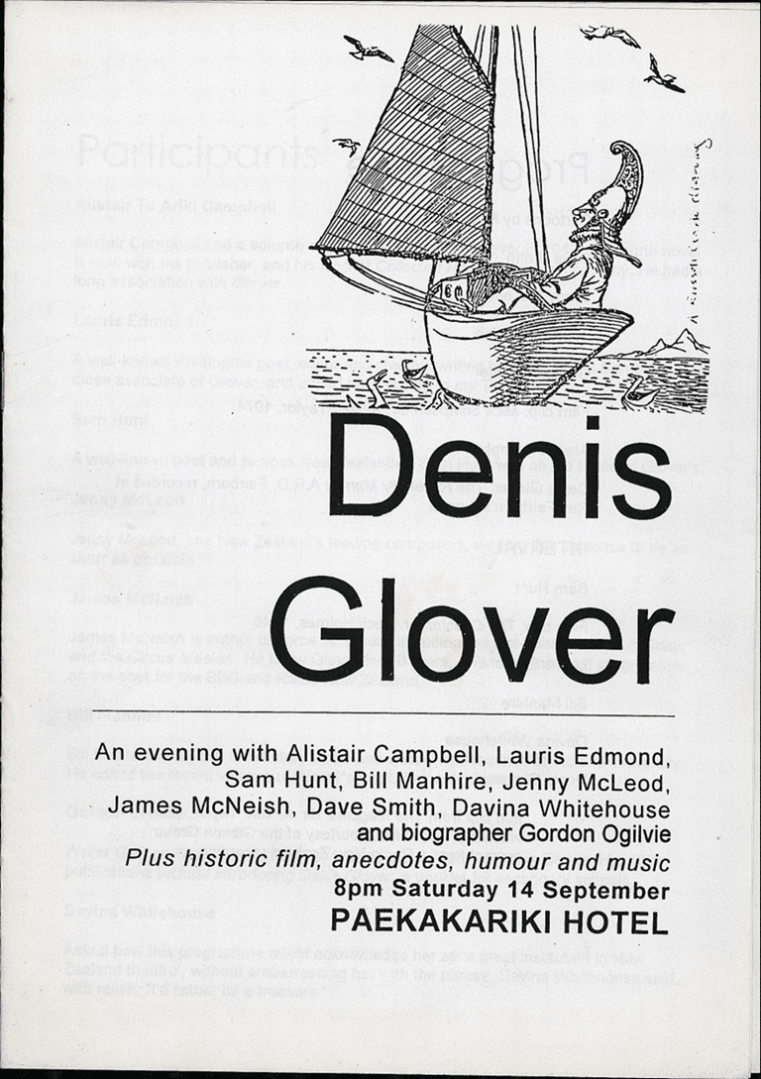
The frontispiece of Friends and Neighbours perhaps sums up Glover best:
‘Denis Glover made Paekākāriki his home during the latter part of his life. He became part of the community as friend and neighbour, even though the relationship was not always an easy one… [He was] “the kind of fellah you got on with or you didn’t.”’[36]
Portrait of Denis Glover by Evelyn Page, Paekakariki, 1968. (held by Auckland Art Gallery Toi o Tāmaki).
The Denis Glover celebration, Paekākāriki Hotel, 14 September 1996.
In the lead up to this event, Paekākāriki author, Frances Cherry, produced a booklet called Friends and Neighbours: Denis Glover in Paekākāriki. This has interviews with various residents about their recollections of Glover.
Writing in Paekākāriki Xpressed (the local rag) in 2006, a decade later, Caryl Hamer noted that the decision to publish Friends and Neighbours was controversial. Some locals felt that Glover’s less appealing behaviour should be ignored, with the focus solely on his achievements as a prominent New Zealand poet. But the editor, Frances Cherry, maintained that ‘it was important to have the story of a warts and all poet, and that Denis himself would have wanted this.’[35]